 English EN
 中国 CN
中国 CN

RaymanTech Whole-Chain Solution: A Deep Dive
Food safety and quality control demands have evolv...
More

The global zucchini and squash market shows significant growth, underscoring the need for advanced processing technology.
| Metric | Value |
|---|---|
| Market Valuation | $22.81 billion |
| Projected Market Size (by 2030) | $30.55 billion |
| Compound Annual Growth Rate (CAGR) | 6% (2025-2030) |
This expansion makes a strategic investment in a zucchini and squash sorting machine essential for long-term profitability. A smart purchase evaluates three financial pillars: the initial price, Total Cost of Ownership (TCO), and Return on Investment (ROI).
The initial purchase price of a sorting machine is a significant capital expense. Growers must look beyond a simple price tag to understand what they are truly paying for.
Every processing operation has unique requirements. A standard, off-the-shelf machine rarely addresses the specific needs of different growers, packers, or distributors.
A one-price model overlooks critical operational differences. Factors like facility layout, crop variety, and target market demands mean that a successful investment requires a tailored solution, not a generic one.
Several key factors determine the final cost of a zucchini and squash sorting machine. Understanding these drivers helps processors align their budget with their operational goals.
Sorting Criteria: Basic machines sort by size and shape. Advanced systems use high-resolution cameras and sensors to detect color variations, surface defects, and even internal quality. More sophisticated criteria demand more complex technology, increasing the price.
Capacity: Machine capacity is measured in tons per hour. A small-scale operation requires a lower throughput than a large commercial processor. Higher capacity machines need more robust hardware and faster processing software, which directly impacts cost.
Automation Level: The degree of automation is a primary price driver. A semi-automated system may require manual feeding, while a fully automated line integrates feeding, sorting, and packing. Full automation significantly reduces labor but carries a higher initial investment.
Standard models provide a baseline price. However, most operations require customization. Add-on features like specialized infeed and outfeed conveyors, advanced data reporting software, or integrated box-filling systems increase the initial purchase price. These additions, while costly upfront, often deliver substantial long-term value by improving workflow and efficiency.
A savvy investor looks past the initial invoice to evaluate the full lifetime expense of an asset. The Total Cost of Ownership (TCO) provides a comprehensive financial picture, revealing the true cost of a sorting machine over its entire operational life. This analysis is critical for making a financially sound decision.
The initial purchase price is often just the tip of the iceberg. Industry data reveals that the upfront cost of processing equipment may only represent 20-30% of its total expense over a decade. The remaining 70-80% accumulates through ongoing operational and ownership costs.
A processor's financial model must account for long-term variables. TCO shifts the focus from "What does it cost to buy?" to "What does it cost to own and operate?" This perspective is fundamental to achieving sustainable profitability.
Major ownership costs include depreciation and interest.
Depreciation is the reduction in the machine's value over time. Processors calculate it by dividing the total investment by the machine's expected useful life.
Interest represents the cost of capital tied up in the investment.
These factors are highly sensitive to the machine's lifespan and the initial investment. A less expensive machine with a short 5-year lifespan can have a much higher annual ownership cost than a more durable, expensive model designed to last 15 years.
Downtime is one of the most significant hidden costs in any processing facility. A single hour of lost production can cost a business thousands of dollars in unrealized revenue. Machine reliability is therefore a cornerstone of a low TCO.
Preventive maintenance is the key to ensuring reliability. Proactive service is far more cost-effective than reactive repairs, as unplanned breakdowns can be three to five times more expensive to fix. A strong partnership with the manufacturer is essential. Leading suppliers offer comprehensive support packages that include:
A standard 12-month warranty on parts and labor.
24/7 technical helpdesks for remote diagnostics and emergency assistance.
Preventive maintenance agreements with scheduled health checks.
Operator training sessions to improve productivity and reduce errors.
Modernization services to upgrade equipment with the latest technology.
Choosing a manufacturer with a robust support infrastructure ensures that help is available when needed, minimizing downtime and protecting the investment.
Daily operational expenses are a major component of TCO. A modern, energy-efficient zucchini and squash sorting machine can yield significant savings. High-efficiency motors and optimized software can reduce electricity consumption, saving a facility thousands of dollars annually.
Spare parts are another critical consideration. While a low initial price is tempting, it may come with expensive or hard-to-find proprietary parts. Reputable manufacturers provide access to original spare parts and offer expert guidance on optimizing inventory to prevent unnecessary holding costs while ensuring critical components are always on hand.
Finally, processors must account for sanitation. A machine designed for easy cleaning and maintenance reduces labor costs, minimizes water and chemical usage, and helps maintain food safety standards.
| Operational Cost | Key Consideration | Impact on TCO |
|---|---|---|
| Energy Consumption | Machine's power rating and efficiency. | High-efficiency models reduce monthly utility bills. |
| Spare Parts | Availability, cost, and inventory management. | Readily available parts minimize downtime and repair costs. |
| Cleaning & Sanitation | Design accessibility and material quality. | Easy-to-clean designs lower labor costs and ensure compliance. |
By carefully analyzing these ongoing expenses, a grower or packer can accurately project the true cost of ownership and select a machine that delivers value for years to come.
While TCO quantifies the total expense, Return on Investment (ROI) measures the profitability of the purchase. A positive ROI confirms that the machine generates more revenue and savings than it costs to own and operate. Calculating potential ROI is the final, critical step in justifying a capital investment in a zucchini and squash sorting machine. It transforms the purchase from a simple expense into a strategic asset for growth.
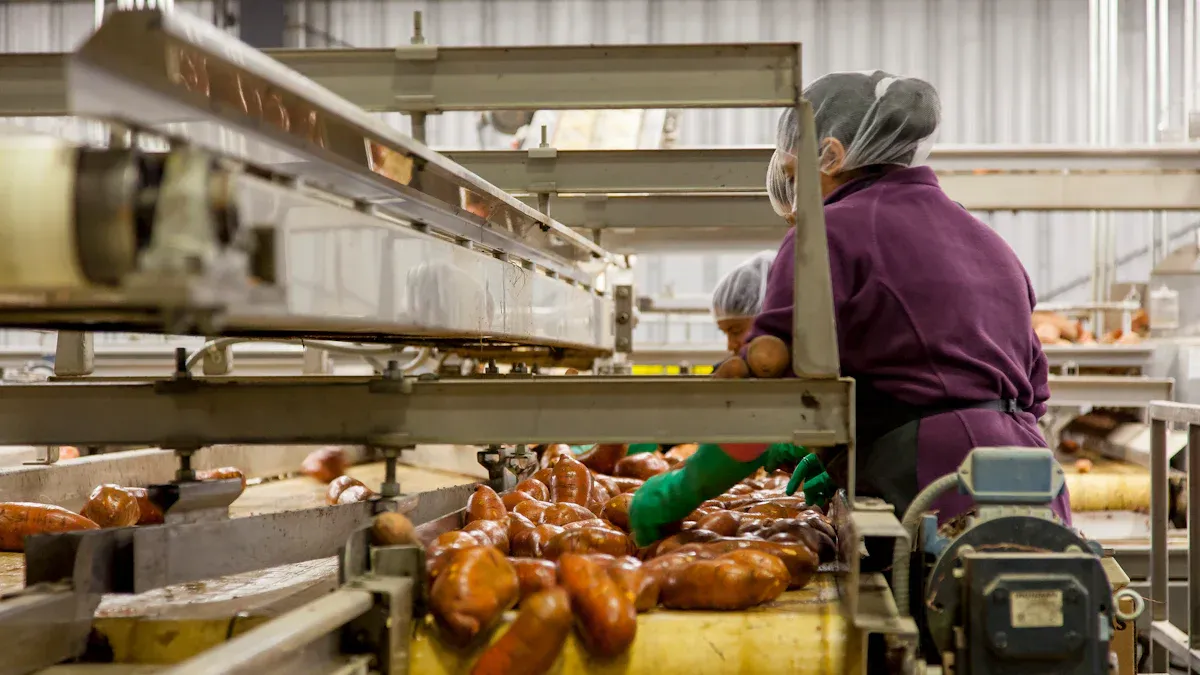
Labor is often the largest and most unpredictable operational expense for growers and packers. Automation offers a direct and measurable solution to this challenge. A sorting machine performs the work of multiple employees consistently and without interruption. This capability allows businesses to reallocate their workforce to higher-value tasks or significantly reduce their overall headcount.
The financial impact is straightforward. A processor can calculate the annual cost of manual sorters, including wages, benefits, overtime, and training. They can then compare this figure to the operational cost of the machine. In many cases, the reduction in labor expenses alone is enough to create a compelling ROI within just a few years. Automation provides stability against rising wages and labor shortages, making it a predictable and powerful cost-control measure.
Speed and accuracy are the twin engines of profitability in produce processing. An automated sorter operates at a consistent high speed, dramatically increasing throughput compared to a manual line. This allows a facility to process more zucchini and squash per hour, boosting its capacity to meet large orders and capture more market share.
More importantly, this speed does not come at the expense of quality. In fact, automated systems deliver a level of precision that manual sorting cannot match. Human sorters are prone to fatigue and subjective judgment, leading to errors. Advanced optical sorters, however, analyze each piece of produce with objective consistency.
| Sorting Method | Typical Error Rate |
|---|---|
| Manual Sorting | 2%–5% |
| Automated Sorting | <0.1% |
This near-perfect accuracy means less premium product is accidentally discarded and fewer defective items reach the customer. The result is reduced product giveaway, minimal waste, and enhanced brand reputation for quality, all of which directly contribute to a stronger bottom line.
A single harvest yields zucchini and squash of varying sizes, shapes, and quality levels. A sophisticated sorting machine empowers growers to unlock the maximum value from every piece. Instead of selling a mixed-quality batch at a flat rate, processors can use technology to segment the crop for different markets.
Advanced systems use high-resolution cameras and AI to grade produce with incredible detail. They can sort based on multiple criteria simultaneously:
Physical Dimensions: Length, diameter, and curvature.
Weight: Precise weight measurements for uniform packaging.
Quality: Color consistency and the presence of surface defects.
Pro Tip: This capability allows a processor to direct premium, unblemished produce to high-end retailers for top dollar. It can route slightly curved or discolored items to food service or processing clients for dicing and canning. This strategy ensures that the entire crop is monetized at its highest possible value, significantly boosting overall revenue.
The theoretical benefits of automation become tangible when examining real-world case studies. While savings vary, stories of dramatic labor reduction are common. For example, Pioneer Potatoes, a grower facing rising labor costs, implemented grading technology and achieved transformative results.
The company successfully reduced its sorting line workforce by 50%, from over 20 people down to just 12. Wylie Thulen of Pioneer Potatoes noted, "The cost savings alone were huge for us." He projected that the investment would pay for itself in just four to five years based on labor savings alone. This figure does not even include the added financial benefits of increased capacity and superior product quality. While this case highlights a 50% reduction, some larger operations have reported cutting labor costs by 70% or more, demonstrating the immense potential for ROI.
Thulen summarized the partnership with his technology provider, stating, "This is an advancement that I didn’t think we could really make. But now we have it, it’s kind of amazing for us." This testimonial underscores how the right investment moves beyond numbers to become a foundational part of a company's success.
An investment in sorting technology extends beyond immediate financial returns. It positions a business for long-term success by transforming its operational capabilities. A modern zucchini and squash sorting machine becomes a strategic asset that builds brand value, optimizes resource use, and secures a stronger market position.
Consistent quality is the foundation of a trusted brand. Automated sorters deliver a level of uniformity that manual labor cannot replicate, ensuring every box meets customer expectations. This technology is also essential for regulatory adherence. Automated systems help processors meet stringent food safety and quality standards with ease.
They provide instant access to quality records and process logs for seamless USDA or international audits.
Equipment built with hygienic design principles minimizes microbiological contamination risks.
Advanced sensors remove foreign materials and detect internal defects, ensuring compliance with food safety regulations.
Precision is profit. Automated sorting systems significantly reduce waste by minimizing sorting errors. They prevent premium produce from being accidentally discarded and ensure defective items do not enter the final pack. Furthermore, precise weight grading ensures each package meets legal weight requirements without costly over-packing. This optimization of the crop minimizes product giveaway, turning potential losses into measurable revenue and contributing to a more sustainable operation.
In today's market, advanced technology is no longer optional; it is a requirement for market access. A remarkable 82% of major grocery chains now mandate that their suppliers use certified sorting technologies. Meeting this demand allows growers to secure and retain contracts with top-tier retailers. This capability also opens doors to new, more lucrative opportunities.
Rivermaid Trading noted that advanced grading technology allowed them to access Asian markets they previously couldn't, including high-end premium markets, due to perfect sizing and near-perfect grading.
This demonstrates how superior sorting directly enables businesses to compete on a global scale, turning operational efficiency into a powerful tool for market expansion.
A smart investment prioritizes long-term value over the lowest initial price.
Processors confidently select a sorting machine by analyzing the purchase price, TCO, and ROI. The right technology becomes a strategic asset. It pays for itself by reducing costs, improving quality, and maximizing revenue for sustainable growth.
Installation timelines vary based on system complexity. A standard machine setup typically requires one to two weeks. Fully integrated lines may need additional time for complete testing and validation.
Yes. Modern sorting machines handle diverse squash types, including yellow and pattypan squash. Advanced software allows operators to switch between different crop programs with minimal adjustments and downtime.
Manufacturers provide comprehensive training for operators and maintenance staff. These sessions cover machine functions, safety protocols, and cleaning procedures. This ensures teams can operate the equipment efficiently and effectively.

We provide you with comprehensive foreign trade solutions to help enterprises achieve global development
.png)
Recommedation: Aquatic products, pet food, candy, ...
Chicken bone inspection, global poultry AI databas...
Recommedation: Chili, walnut, peanuts, soybeans, c...
Automatic recognition and rejection, fish bone ins...
Select the most popular foreign trade service products to meet your diverse needs
Select the most popular foreign trade service products to meet your diverse needs







User Comments
Service Experience Sharing from Real Customers
Michael Rodriguez
Farm Operations ManagerThis zucchini and squash sorting machine has revolutionized our harvest processing. The accuracy and speed are incredible, reducing our labor costs by 40% while improving sorting quality. The automated size and quality grading is perfectly calibrated for our produce.
Sarah Chen
Processing Plant SupervisorOutstanding performance! The machine handles both zucchini and squash with remarkable precision. The gentle handling prevents bruising, and the customizable sorting parameters allow us to meet different customer specifications. Maintenance is straightforward and downtime is minimal.
David Thompson
Agricultural EngineerHighly efficient sorting solution that has significantly improved our packing line throughput. The vision system accurately detects defects and the mechanical sorting is consistently reliable. The only minor issue was the initial setup, but technical support was excellent.
Jennifer Williams
Produce Distribution ManagerThis sorting machine has been a game-changer for our distribution center. It processes both zucchini and squash at impressive speeds while maintaining excellent accuracy. The ability to sort by size, color, and quality has helped us maximize product value and reduce waste significantly.